Posts mit dem Label Thermoplast werden angezeigt. Alle Posts anzeigen

Montag, 8. November 2010

Ad Thermoplast

A guy who goes by the name of cr0sh on the Arduino Forums, who has been giving me all kinds of interesting suggestions, wrote a comment on thermoplastics. I will just copy paste it over here, in case anyone who has been following what I am doing is interested.

Personally, while the stuff *is* amazing, I am quite happy to announce, that it no longer is the main structural component of my set up.

Anyway, here goes chr0sh's post:

I noticed you are moving to customized forms using thermoplastic (Turbocast from Streifeneder, Apolit from Minke Props).

Whether or not it will help you (though it might help others, so you might want to reference it on your blog?), such plastic is known by a couple of different names in English:

"PolyMorph"
"Friendly Plastic"
http://www.instamorph.com/
http://shapelock.com/
...among others - its chemical name is:

Polycaprolactone (PCL) - http://en.wikipedia.org/wiki/Polycaprolactone

One place I found that sells "bulk" (not sure if "to the public", though) is:

http://www.absorbables.com/standard.htm

They also have "sample kits". You can also find this plastic on Ebay quite often, typically sold as plastic for jewelry making; it comes in a wide variety of colors (including metallics). Standard forms I have seen (before seeing your samples), have been a flat "stick" form, and pellets.

In the US, I have seen it sold in craft stores, and the friendly plastic is available from Target stores.

By the way, cr0sh has a website: phoenixgarage.org check it out :-)

Samstag, 23. Oktober 2010

Some Pictures of new Prototype in Action


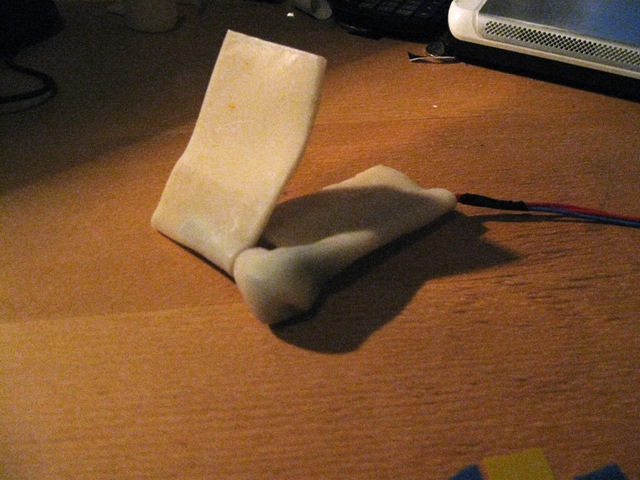
Connecting Thermoplast to Sensors

(I will comment on these later. Right now I just want to upload these so I can fool around with some new stuff.)


Turbocast: Low Temperature Thermoplast (Streifeneder)

A couple of days later I received a parcel from Streifeneder with some of the 'Turbocast' which they produce.


Turbocast was much more difficult to mold. It stuck glued to my tools. It glued to the hair on my hand, which was sort of painful ... (I ended up shaving my hand before continuing experimenting with Turbocast). Somehow this material just felt more stubborn than Apolit.

However, eventually I got used to the material and was able to get some decent results out of it. More on that topic soon.


Apolit: Low Temperature Thermoplast (Minke Props)

A couple of days ago a received a sample of Apolit, a low temperature Thermoplast by Minke Props.

First off, I have to say that I love this stuff. Where it not rather expensive, I would buy a ton of it...

It was quite easy to mold, I did not burn myself, nor did it pull out any hair after having hardened on my hand. If you need material for instant prototyping this is very interesting stuff.

Take a look at how my first encounter with Thermoplast went.


If you toss it into boiling water it turns soft and transparent in under a minute. I assume you could also bake it in the oven, though it would definitely need a much higher temperature. I was a bit worried that this material might melt if left in a car or something. However I think that would require very, very high temperatures (not saying these are impossible) as air is not all that good in transporting heat. I think its really the fact that water 'transports heat' so well which makes this work so effortlessly.

If you don't like the way its molded, just throw it back into the water. It will go back to its original (flat) shape and become moldable again.


Cutting it is no big deal, however if you use thicker material that could be a pain. I figured this out later, but obviously if you cut it while its still soft. A knife or scissors would go through it like butter.
I also tried sanding it, which did not work very will. Sanding it feels like rubbing an eraser on paper. Carving it with a sharp knife works better. Sawing it should work fine.


I added some self adhesive Velcro. This works sort of fine, but if you want something really permanent, you may want to additionally secure it with screws or something. 


By the way. I hope to soon receive a ton of sensors by images. This 'wristband' will then be used for mounting the stretch sensors for measuring arm rotation. More on that in a later post thought.